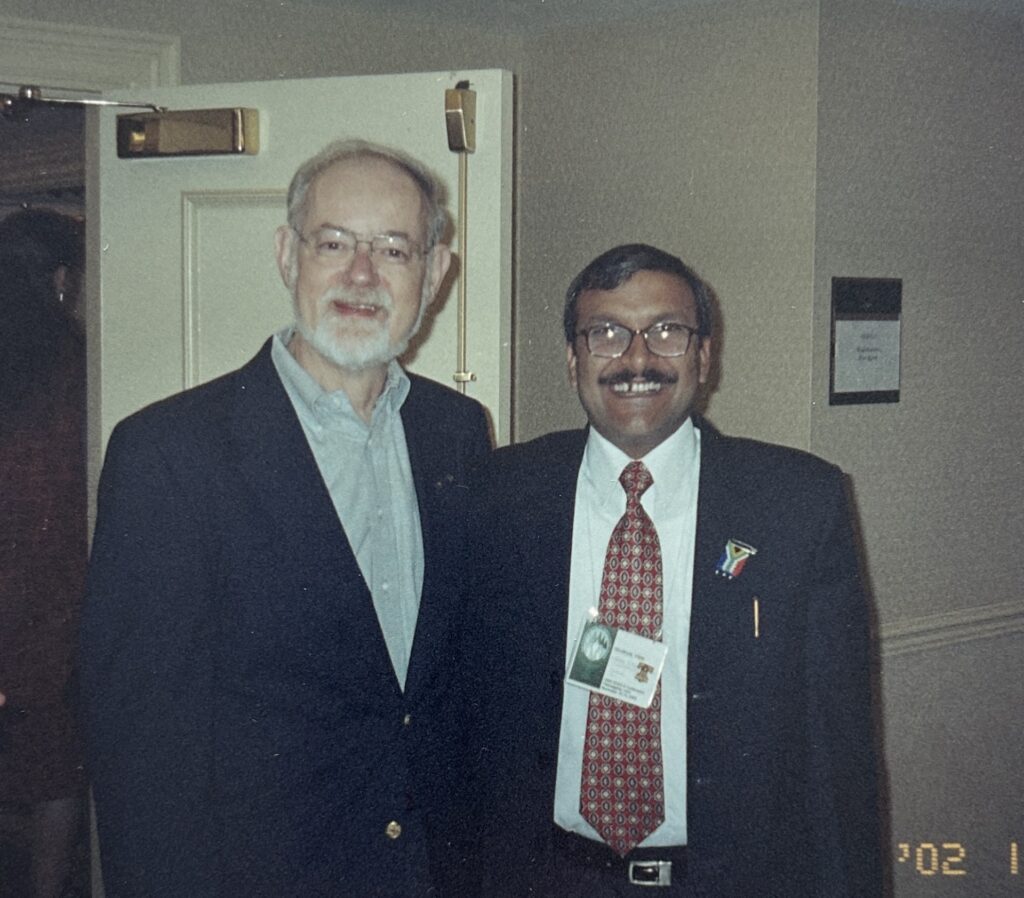
The news of Professor Richard J. Estes‘ passing on 15 July 2026 reached me through an email from my long-time friend and quality-of-life scholar from Argentina, Professor Graciela H. Tonon. My immediate response was disbelief. I searched the internet, hoping to find some clarification, perhaps even a correction. There was nothing. As more messages from colleagues began to arrive, the painful truth slowly settled in—Richard was no longer with us.
For me, this was not merely the loss of a distinguished scholar. It was the loss of a mentor, collaborator, and a dear friend whose ideas profoundly shaped my own intellectual journey over the past twenty-two years.
(2004, Philadelphia)
My association with Richard began in 2004 when he invited me to attend the International Society for Quality-of-Life Studies (ISQOLS) conference in Philadelphia. Long before I landed in the United States, Richard had already demonstrated the generosity that would define our relationship. He personally ensured that I received all the documents necessary for my visa and even arranged my accommodation with one of his close friends from the University of Pennsylvania. For a young academic travelling halfway across the world, these gestures meant far more than logistical support. They reflected the warmth and humanity that Richard extended to scholars from every corner of the world.
Although I first met him briefly during the conference registration, it was a conversation over coffee the following day that became the true beginning of our friendship.
As we stood in the delegates’ lounge, we watched participants routinely discard half-eaten meals and nearly full bottles of soft drinks. Looking at the overflowing bins, Richard remarked quietly, the developed world wastes so much.
Inspired by my own experiences in Bhutan and my reflections on consumer societies, I responded, “Perhaps we need a Dustbin Index to understand national development. The larger the dustbin, the more developed we think a nation is.”
Richard laughed wholeheartedly. More importantly, he paused to explore the idea. That moment revealed something remarkable about him. Despite being one of the world’s leading scholars of social indicators, he remained genuinely curious, willing to entertain even an unconventional thought from a relatively young researcher. Looking back today, I realise that our friendship began not because we agreed on everything, but because we shared a common willingness to question conventional assumptions about progress.
Our conversations soon turned towards Bhutan and Gross National Happiness, the subject of my presentation. Richard was fascinated that a small Himalayan kingdom had dared to tell the world that happiness mattered more than Gross Domestic Product. He wanted to understand not merely the policy but the philosophy behind it—how ordinary people experienced well-being and how governments could consciously create conditions for human flourishing.
Those discussions profoundly influenced my own thinking. My years in Bhutan had convinced me that every human being aspires to live a happy and meaningful life. Richard’s research provided the empirical foundation for that belief. His pioneering work on the Index of Social Progress demonstrated that genuine development cannot be understood through economic indicators alone. Growth matters because it creates resources, but those resources must ultimately improve people’s lives.
Over the years, our conversations continued across continents—from Berlin and Innsbruck to Luxembourg. We collaborated on academic projects, including a chapter on the history of human well-being in South Asia and later the volume Human Well-Being and Policy in South Asia. Throughout these collaborations, Richard was a meticulous editor, an encouraging mentor, and an intellectually generous colleague. He challenged ideas without ever discouraging the person presenting them.
Perhaps the greatest lesson I learnt from Richard was that scholarship and humanity are inseparable. He believed deeply that behind every statistic lies a human story. Social indicators were never merely numbers for him; they represented children’s education, families’ security, people’s dignity, and communities’ opportunities to live fulfilling lives. His work consistently reminded policymakers that economic growth is meaningful only when it translates into social progress and human well-being.
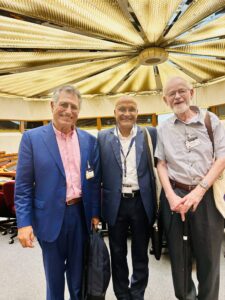
(2025, Luxembourg, with Richard & Joe Sirgy)
My last meeting with Richard was during the 23rd ISQOLS Conference in Luxembourg in 2025, celebrating thirty years of the ISQOLS that he had helped establish. Time had slowed his physical movement, and he walked with the support of a stick, yet his intellectual curiosity remained undiminished. His memory was astonishing. He effortlessly recalled conversations we had shared years earlier in Philadelphia, Berlin, and Innsbruck. More than the discussions themselves, I remember his presence—humble, attentive, and genuinely interested in every scholar he met. In an academic world that often rewards self-promotion, Richard quietly demonstrated that kindness and intellectual excellence could coexist.
As I reflect on twenty-two years of knowing Richard, I realise that his greatest legacy extends beyond his influential scholarship. He taught an entire generation of researchers to ask a different question. Instead of asking how wealthy nations have become, he encouraged us to ask how people are actually living. Instead of celebrating growth for its own sake, he reminded us to examine whether growth creates justice, opportunity, dignity, and happiness.
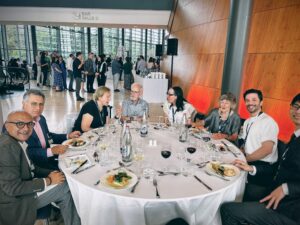
(2025, Luxembourg, Conference dinner, with Richard, Graciela, Valerie Moller, & Joe)
The conversation that began over a cup of coffee in Philadelphia continues to shape my own work today. Whenever I think about development, public policy, or human well-being, I find myself returning to Richard’s simple yet profound conviction: the true measure of progress is not the wealth a nation accumulates, but the quality of life it enables its people to live.
Richard J. Estes leaves behind a remarkable body of scholarship, but he also leaves behind something even more enduring—a community of scholars inspired by his generosity, his humility, and his unwavering commitment to building a world where social progress matters as much as economic growth. I count myself fortunate to have walked a small part of that journey with him. His ideas will continue to guide my work, and his friendship will remain one of the greatest blessings of my academic life.

1 thought on “Remembering Richard J Estes (1940-2026)”
Beautifully written sir. May his noble soul rest in peace!