My morning travel to the office usually begins with a small ritual. Before I call anyone, open my iPad or a book, or turn to the day’s agenda, I open Wordle and try to solve it. Five or six minutes of quiet puzzling before the day begins. Over the years, it has become a small mental exercise—almost a way of warming up the mind before everything else demands my attention.
Year after year, streak after streak, the habit has also become something I share with my daughter. We often send each other our Wordle screens, sometimes comparing how many attempts we needed, sometimes turning it into a friendly competition to see who can crack the word first.
Of late, she has started telling me, “You have learnt it well.”
I feel rather flattered. Such a compliment from a Gen Z daughter is quite something.
On 31 August 2026, we were travelling together. True to habit, I opened the day’s puzzle. I did not expect that this particular Wordle would become a story worth remembering and sharing, let alone one with a lesson attached to it.
But that is often how lessons arrive—in the middle of something ordinary, without invitation.
The Puzzle Begins: Wardle‘s Wordle
Usually, I begin with one of four words: RAISE, ARISE, ROUTE, or IDIOT. For Wordlers, the first challenge is to find the right combination of vowels and, eventually, the right word.
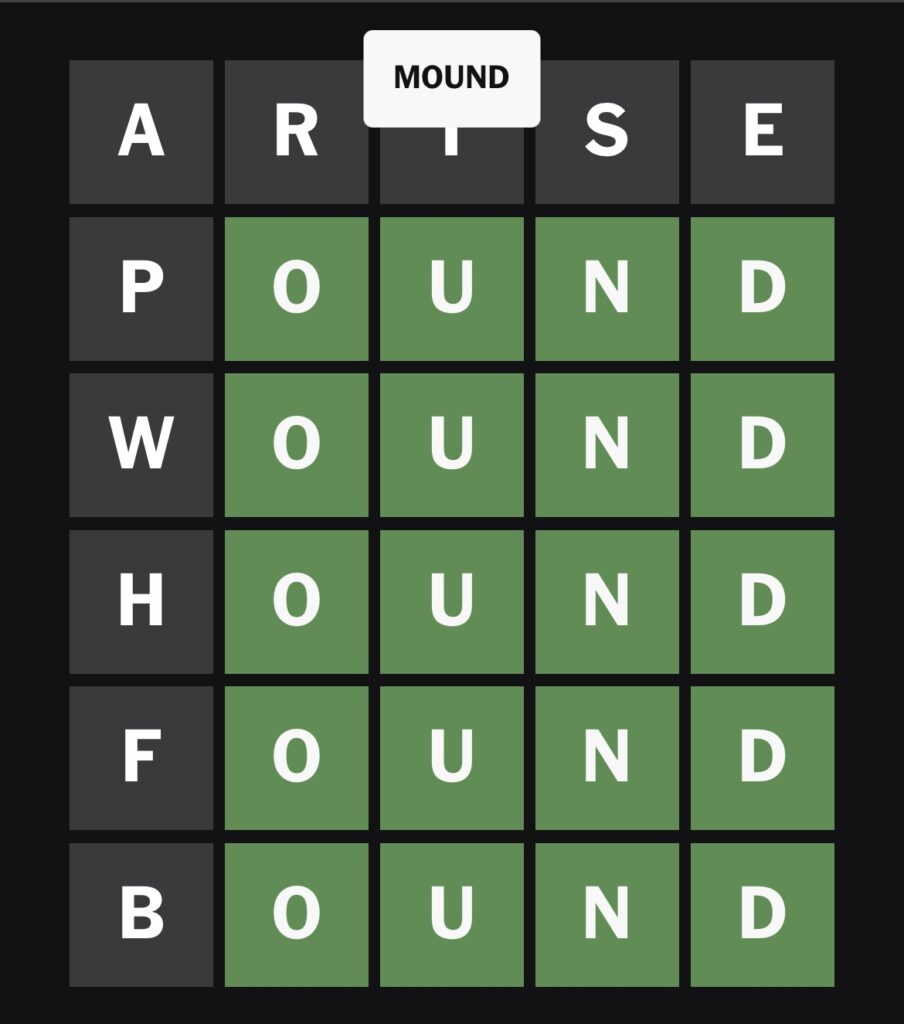
That morning, I chose ARISE.
Nothing matched. Not one letter.
It was an unusually humbling beginning. In Wordle, when the first attempt gives you nothing, you are left with little except probability, intuition, and the willingness to try again. For a moment, I stared at the screen, wondering where to go next.
Fortunately, Wordle gives you six attempts. There is something reassuring about another chance.
So I moved to my second guess: POUND.
This time, something extraordinary happened. Four of the five letters lit up green, sitting exactly where they should. Only the first letter was missing.
I could hardly believe it.
In all my years of playing, I could not remember a second attempt landing this close to the answer. After getting nothing right on the first attempt, I had suddenly moved to what felt like 80 percent certainty on the second.
The contrast was almost amusing. One moment, I had nothing. The next, I was almost there.
It felt as if I had practically solved it.
I remember thinking, Surely the third attempt will finish the job.
But that was where the trouble began.
Getting close is not the same as getting there. Knowing four letters is not knowing the word. And sometimes, the confidence that comes from sudden progress can be more dangerous than the uncertainty with which we began.
The first attempt had taught me something about humility. The second had given me confidence.
I was about to discover how quickly confidence can turn into certainty.
Where Confidence Got Ahead of Me
With O-U-N-D locked in, I only needed the right first letter. But somewhere between the second and third attempts, my thinking had subtly changed. I was no longer asking, What could the word be? I had already decided that the answer was a word ending in OUND. My mind had moved from exploring possibilities to confirming a conclusion.
I tried WOUND.
It felt almost too easy. The word fitted perfectly, and I was fairly certain I had it. I pressed enter with the quiet confidence of someone who had already solved the puzzle.
Wrong.
For a moment, I was genuinely puzzled. If OUND was right, what else could it possibly be? I could not think of another word that made as much sense as WOUND. That, I realised later, was the first real lesson of the morning:
I was no longer solving the puzzle; I was defending an answer.
We do this in life more often than we realise. We form an opinion about a colleague, a student, a situation, a research finding, or even a relationship. Once an explanation feels right, we begin interpreting everything through it. Evidence that supports us becomes important; evidence that challenges us becomes an exception.
The mind likes closure.
Daniel Kahneman and others have shown us how readily we rely on mental shortcuts—anchoring, certainity, overconfidence, confirmation, availability and other biases—to make sense of the world. I was experiencing a very simple version of the same phenomenon on my Wordle screen.
The puzzle had given me four green letters. I had turned them into certainty. I regrouped and tried FOUND, telling myself that this must be the word I had somehow overlooked.
Wrong again.
Now a small knot of worry began to form—the kind you feel when something that should be simple keeps refusing to resolve. The problem was no longer the puzzle. It was my thinking.
Perhaps life has its own version of this experience. We move through a situation assuming that everything will be smooth and predictable. Then something does not work. A plan fails. An initiative encounters resistance. A student does not respond as expected. A research finding contradicts our hypothesis. A carefully made decision produces an unexpected outcome.
Our first instinct is often to ask, Why is this happening? Perhaps the more useful question is:
What is this asking me to reconsider?
I tried BOUND next, with a little less conviction than before and a little more hope than logic.
Still wrong.
Four green letters were staring at me, and yet the answer remained invisible. By the time I reached my sixth and final attempt, I was no longer confident. I was simply anxious to close the matter. I typed HOUND, half expecting it to fail and half willing it to work anyway.
Wrong once more.
I had used every attempt. The screen delivered its quiet, slightly deflating message. ‘Thanks for trying.’ I had lost.
In all the years I have played Wordle, I think this was only the second time I had exhausted all six attempts without finding the word. I sat there for a moment, looking at the six guesses and those four green letters that had been sitting there almost from the beginning. Then the answer appeared:
MOUND.
I stared at it.
MOUND.
The word I had not even considered. And that was the part that stayed with me. The answer had not been obscure. It had not been hiding behind some complicated combination of letters. I already had O-U-N-D. The missing letter was right where I had been looking all along. What I lacked was not information.
I lacked possibility.
I had become trapped inside the small circle of answers that felt obvious to me: WOUND, FOUND, BOUND, HOUND. Once those possibilities occupied my mind, MOUND simply did not enter the room.
It made me think about how often this happens beyond Wordle.
- A manager may assume that an underperforming employee is simply unmotivated, when the real issue may be lack of clarity or support.
- A teacher may conclude that a student is weak in a subject when the student may simply be struggling with the way it is being taught.
- A researcher may become attached to a hypothesis and spend more time explaining away contradictory findings than reconsidering the hypothesis itself.
- In organisations, we can become so accustomed to solving a problem in one particular way that we fail to notice a simpler possibility sitting just outside our frame of reference.
And perhaps this happens in our personal lives most of all. We sometimes decide that a relationship cannot be repaired, that a career path has closed, that a person will never change, that an opportunity is not for us, or that a problem has only one possible solution.
Not necessarily because we have examined every possibility, but because we have become comfortable with the possibilities we already know.
The irony of my Wordle that morning was that I had been given almost the entire answer in my second attempt.
Four out of five letters were correct. I was at 80 percent. Yet 80 percent certainty became a trap rather than an advantage. Perhaps that is one of the strange things about life: sometimes knowing too little forces us to remain open, while knowing almost enough can make us dangerously certain.
Stay Humble
My daughter had been sitting right next to me through all of this. She had watched the entire drama unfold—the confidence, the guesses, the growing frustration, and finally the discovery of MOUND.
The moment she saw the mobile screen, she uttered just two words:
“Stay humble.”
It was such a simple response. But it stayed with me. Perhaps she was right.
My first attempt had taught me not to give up. My second had taught me that progress can create overconfidence. The next few attempts had taught me to question my assumptions. And the final answer had reminded me that sometimes the solution is not beyond our knowledge; it is simply beyond the boundaries of our current thinking.
Herbert Simon‘s idea of bounded rationality offers an interesting way of looking at this. Our decisions and judgments are inevitably shaped by the limits of the information we have, the time available to us, and, perhaps most importantly, the range of possibilities we are able to see. In my Wordle that morning, the answer was not hidden from me. I had four of its five letters. What was limited was not the information available to me, but my ability to imagine the possibility of MOUND.
A Wordle game is, of course, a very small thing. But perhaps that is precisely why its lesson is useful. It reminds us that being rational is not simply about having information or reaching a conclusion; it is also about recognising the limits within which we are thinking.
We do not always need more information. Sometimes we need to step back from what we think we know, loosen our grip on the answer that feels obvious, and make room for another possibility.
Looking back, the little puzzle left me with four reminders that extend well beyond Wordle:
- humility to accept that we may be wrong;
- confidence to keep trying when the first attempt fails;
- openness to consider possibilities that do not immediately occur to us; and
- patience to resist the urge for premature closure.
Perhaps the wisdom lies not in choosing between confidence and humility, but in knowing when each is needed.
A Wordle game is, of course, a very small thing. Yet sometimes the smallest experiences hold up the clearest mirrors. That morning, the mirror showed me something quite simple: having four of the five letters is progress, but it is not the answer.
And perhaps that is true of life as well. Stay humble.
The next morning, as usual, I opened Wordle before beginning my day. This time, I smiled before making my first guess.
Stay humble.
also read:
Thinking fast and slow – review
Education is not an event but an experience.

1 thought on “STAY HUMBLE: LESSONS FROM WORDLE”
As an educator your experience resonates deeply with what we witness in the every day classroom. You have reminded us our job as educator not just providing information, but to actively build cognitive skills among the students. Quoting in your own words “sometimes knowing too little forces us to remain open, while knowing almost enough can make us dangerously certain.” made me to understand how confirmation bias works in research and problem solving.